
The Long Tail to 100% Autonomous Codebases
For thirty years the atomic unit of software work has been one engineer, one branch, one pull request, one reviewer. Every piece of development infrastructure we built assumes that shape. CI queues sized for two or three jobs. A single staging environment that six people coordinate over in Slack. A README that says "clone this and follow the twelve setup steps," which works because a human only does it once.
The Repo Is the Bottleneck
Now, code throughput has multiplied exponentially.
An engineer now kicks off four agents before lunch and keeps writing code locally while they run. Five engineers doing the same thing is twenty concurrent pull requests against a codebase whose scaffolding was designed for two. The reviews pile up. The staging environment thrashes. Someone's agent opens a PR that can't be tested anywhere except in someone's head. The code stopped being the bottleneck. The repo became the bottleneck.
The genuinely hard problem is the interleave: human work on laptops and agent work in cloud sandboxes landing in the same trunk, at the same time, against the same dependencies, without getting out of sync with each other. That is not a model problem. It is an environments and governance problem, and it feels largely unsolved and/or gate-kept by high performance organizations. However, it is the difference between the same team shipping at 4x productivity vs. 100x productivity.
The New Addition to CI/CD
Environments are typically something a repository graduates into. They are the substrate that makes concurrent work possible at all, and a repo that can't give every type of branch somewhere to run is a repo that can only absorb one change at a time.
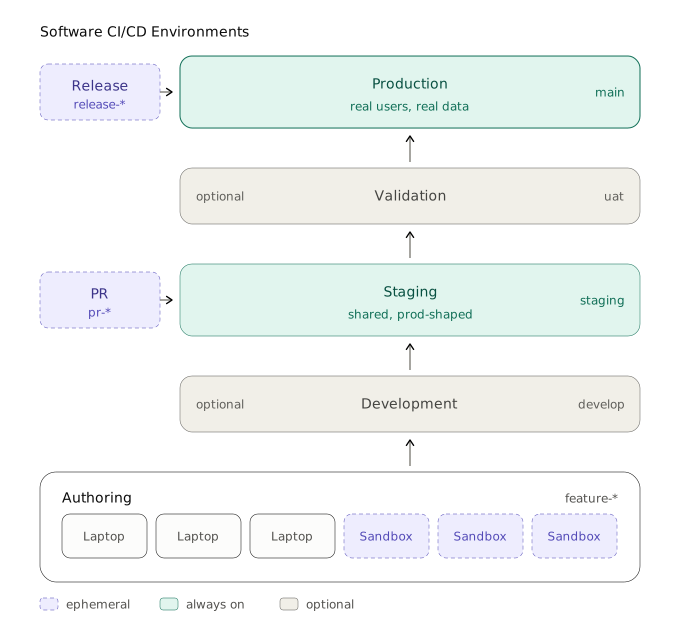
The permanent tiers are pinned to permanent branches. The ephemeral tiers are conjured by pattern-matching a branch name — pr-, release- — and destroyed when that branch goes away. Nothing about that should require a human to configure anything. Authoring is now both an individual laptop experience and a cloud sandbox experience, but it is painfully non-trivial to keep the two in sync.
Problem 1) Atomic environments now come in two shapes
New code gets authored in exactly two places, and a serious setup treats both as first-class.
A laptop is the fastest possible loop and costs nothing, but it drifts. State accumulates, CLI versions diverge, and the gap between "works on my machine" and persistent environments widens invisibly.
A cloud sandbox runs into the same issues except the issues are harder to keep up to date. CLIs, MCPs, and third-party access etc. must be authenticated in the sandbox via either user-level authorization or team-level authorization for all services used. Furthermore, networking protocols and IP address handling is more complicated in a sandbox than on a personal laptop.
Most teams today have the first and improvise the second. The improvisation is where agent-written work goes to die: no credentials, no CLIs, no MCP servers, no way to run the integration suite. The sandbox has to be a real, provisioned, opinionated environment, or you are asking an agent to build a house with no lumber.
Problem 2) Ephemeral environments require complex glue
Spinning up a container per pull request is the easy half, and it's the half products in this space demo. The hard half is properly building, snapshotting, updating and seeding the ephemeral PR environment with just enough substance to test the PR. Simple PRs become impossible to test:
What happens to third-party integrations: does every PR environment hit the real Stripe sandbox, share one, or get a fake?
What are its connections to base APIs it doesn't own, and who pays for them?
What database migrations should be run and what data should be seeded?
How do you handle PR concurrency against configurations that are duplicated from base branches?
This challenge routinely breaks fragile designs, and it has to hold at massive concurrency. Twenty simultaneous PR environments, each wanting a database, each wanting integration credentials, each spinning up and tearing down within the hour. A design that works for two will fall over at twenty, quietly, in a way that shows up as flaky tests and lost afternoons.
Ephemeral environments need strong opinions here, shipped by default. Left to each team, this gets decided ad hoc by whoever is in charge. I would argue this is the biggest hurdle for existing technology organizations that are working with legacy stacks. This is what makes 100x developer productivity impossible at most organizations.
Problem 3) Vendor Lock-In
When shipping 0 -> 1, developers have to make multiple technology choices every day.
What frontend? — Next.js and React.
What styling strategy? Add Tailwind.
- What component library? Untitled UI, a real design system, and auth on day one rather than day ninety.
What backend? — TypeScript or Python
ORM? -- a Drizzle ORM against a persisted SQL instance, and a generated OpenAPI spec.
- What database — Postgres, provisioned and connected. A database GUI — an internal tool for manipulating data without writing psql by hand.
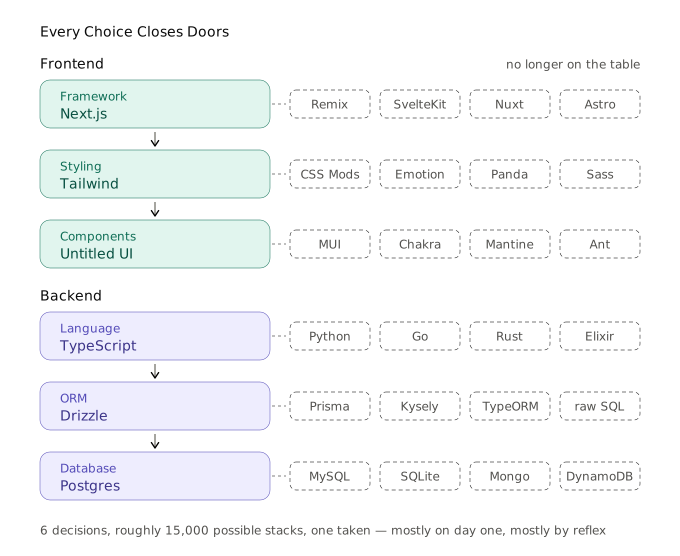
As you can see, each decision takes you down a certain path. One vendor closes you off from other choices or locks you into an infrastructure that is quietly blocking you from shipping more and more software via cloud sandboxes. These choices can largely be traded off ahead of time with something as simple as a SKILL.md that can battle test full-stack choices over the latest public documentation from the source material of the companies shipping the SDK, library, framework, etc.
A codebase that can groom itself, continuously
Code quality has always been a discipline problem — you fix the structure when you have time, and you never have time. At twenty concurrent PRs, discipline stops scaling entirely. Entropy arrives faster than any human can review it away.
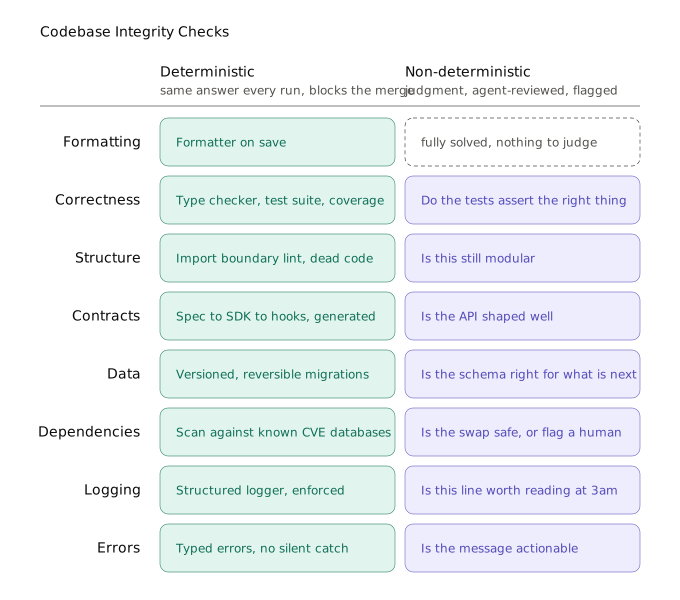
So the grooming has to now be always-on, agent-driven AND also traditional (the baked in formatters, linters, etc. in the codebase):
Logging that stays clean and consistent throughout the app.
Environment variables that maintain one source of truth, always current, never scattered across four dashboards.
Inter-service consistency, enforced mechanically: OpenAPI spec generated from the API, frontend SDK generated from the spec, hooks generated from the SDK. The frontend cannot drift from the backend because it isn't hand-written.
Intra-service consistency: modular patterns inside each service that scale horizontally instead of accreting.
Security: dependency vulnerabilities resolved automatically where a swap is safe, flagged loudly where it isn't.
Testing: unit, integration, migrations, regression — not aspirationally, but as a gate.
Type safety end to end.
With AI-driven coding, there is a distinction that matters: deterministic gates that always run on commits, before PR merges etc. vs. always-on, self-grooming strategies. The latter are the wet dreams of all those engineers out there crashing out at 3am while on-call because something broke production.
Problem 4) PR Merging is now a real queueing problem
When PRs arrived one at a time, "merge when approved" was a sufficient policy. At twenty at a time, it is not a policy at all — it's a race condition, a bottleneck, and a huge human time sink.
What should replace it is a standalone merging engine. Let's walk through the modern development flow: Linear/Jira Ticketing kicks off work - A bug report or feature request gets triaged and assigned to the queue it belongs in — humans or agents — pick off what to work on and ship a PR. Humans pick off tickets and spawn agents accordingly (and for the most part, still hand-hold the execution to completion via an agent locally or on the cloud). For an agent to ship a large end to end feature, humans have to still do a considerably amount of grooming ahead of time, hand-hold the execution of each chunk of work and unblock agents when they are deviating or need human credentials. That's what keeps teams from graduating from 4x to 100x productivity.
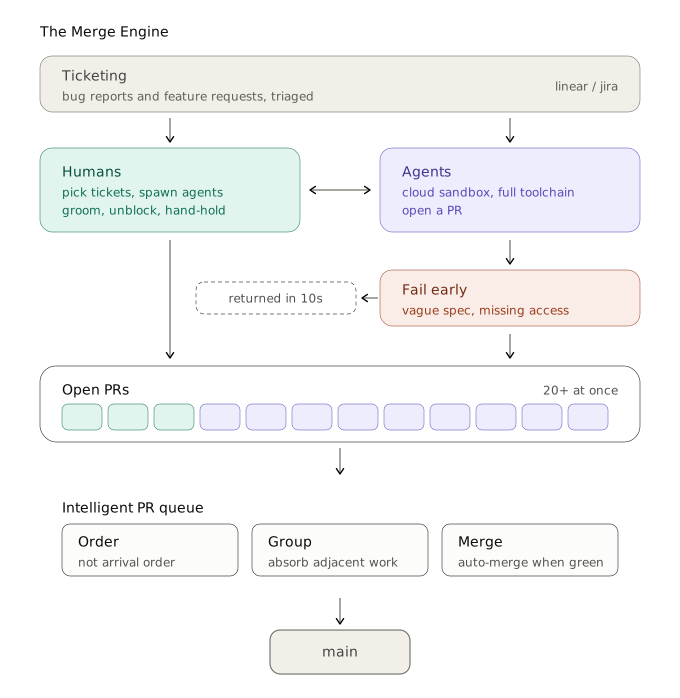
PR queuing that optimizes merge order rather than accepting arrival order, because the order you merge twenty branches in determines how many of them conflict. Auto-grouping, so long-running work sub-branches into a parent branch and absorbs adjacent changes instead of diverging for three weeks and landing as a catastrophe. Fail-early awareness. If a job is too abstract, if the requirements are vague, if the sandbox lacks the CLIs or MCP servers or access the task requires — kill the run immediately. A confidently wrong agent that runs for forty minutes is worse than one that stops in ten seconds and says the ticket was underspecified.
Fail-early deserves emphasis because it inverts a reflex. We are trained to make systems resilient, to retry, to degrade gracefully. When compute is spent on speculative work, the humane thing is to fail loudly and early, and give the time back. This structural shift in development requires dedicated offerings on market that don't quite exist yet -- let's call it an intelligent PR-queue that auto-groups and auto-merges. This feels relatively easy to ship as well.
The Solution
This is the first article of a multi-part article series where we go deep on the topic of the 100% autonomous codebase, offering solutions to all of the problems we discussed above. If you want to join a small group of 3-4 elite engineers working on this problem -- shoot me a line at vihar@larza.ai!